Understanding what makes an AI-generated essay stand out is something students, educators and authors are increasingly interested in. With the rise of AI writing tools, being able to detect AI writing is a valuable skill. If you’ve written an essay with an AI tool or are curious if content sounds like it was written by a human, knowing what makes an essay written by AI writing detectable is key. Here, we explain what AI writers look for to spot AI writing, present five tools to check for AI writing, and offer tips to make your essays indistinguishable from humans.
Understanding how to spot an essay written by AI writing can help avoid potential academic warnings or content filters. But this doesn’t mean it’s impossible to use AI writing tools without detection.
What Does a Typical AI-Written Essay Look Like?
There are common patterns in AI-generated essays that differ from human writing. With a bit of practice, they are easy to recognise.
Common Signs of AI-Generated Text
- Very consistent sentence length: AI tends to generate sentences with similar pacing. People tend to use a mixture of simple and more complicated sentences.
- Overuse of Generic Filler Phrases: AI tends to use phrases such as “It is worth noting that” or “Finally, it’s worth remembering that”. These add bulk but not substance.
- Generic word choices: AI chooses neutral words. Authors may use slang, industry-specific language, or their own voice.
- No personal stories: Human essays contain personal experiences. The examples are generic, as AI has no personal memory.
- Impeccable grammar: AI rarely makes the tiny grammar decisions or risks that make a writer’s style distinct.
- Low perplexity and burstiness: AI detection tools measure the predictability of the text. AI’s writing is very predictable, which is a key feature of any AI detector.
Here’s an example: tell two people to write a paragraph about climate change. A human writer might begin with “I remember when I was a child, and I saw a dried-out lake”. An AI might start with ‘Climate change is one of the most pressing issues of our time,’ a safe but very predictable opening.
How Does AI Essay Detection Actually Work?
AI essay checkers use statistical models that are trained on human and AI-generated text. Here’s how they work.
Perplexity and Burstiness
The main metrics for detecting AI writing are perplexity and burstiness. Perplexity is a measure of the language model’s surprise. Perplexity is low for AI writing because it uses safe word pairs. Burstiness measures how complex sentences are. Humans tend to write in bursts, varying the sentence structure from complex to simpler. AI typically writes at a consistent pace, which is a telltale sign for AI detection.
Pattern Recognition
AI detectors are trained on millions of pieces of writing. They identify patterns of structure, common phrases and quirks that are typical of GPT-4, Gemini or other models. These are fingerprints on the document. The text might be paraphrased, but there are enough traces of the fingerprint to catch an AI that has been well-trained in AI writing.
Watermarking
To increase the accuracy of AI writing checkers, some AI providers are watermarking their text. These can be identified by special tools even when the text is slightly edited, increasing the accuracy of AI-generated text detection over time.
The Stanford team and others keep developing these tools, but they are not 100% precise. There are also false positives (human writing mistakenly detected as AI), especially for non-native English speakers who tend to have a more formulaic writing style.
Five AI Writing Detectors to Check Your Essay
To find out if your essay will be detected, use an AI writing checker. Here are five to try.
1. GPTZero
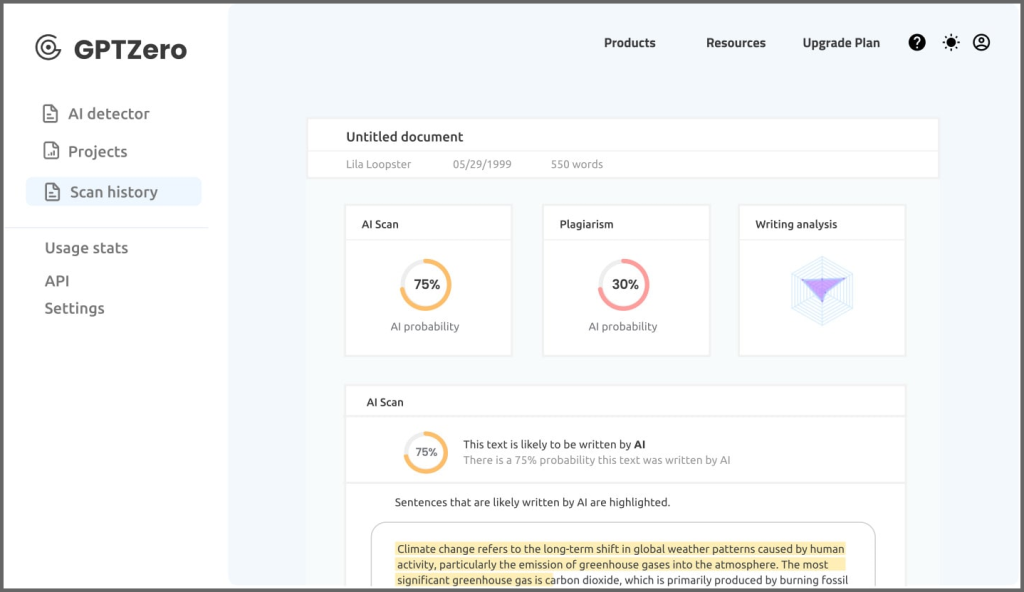
GPTZero is one of the most popular AI content detectors, designed for teachers. It identifies sentences that it thinks are AI-generated and offers a class report for educators grading multiple papers. You can also drill down by sentence, so you can see which ones were flagged and edit them. The free plan allows for up to 5,000 characters, and should be fine for most student writing.
2. Originality.AI
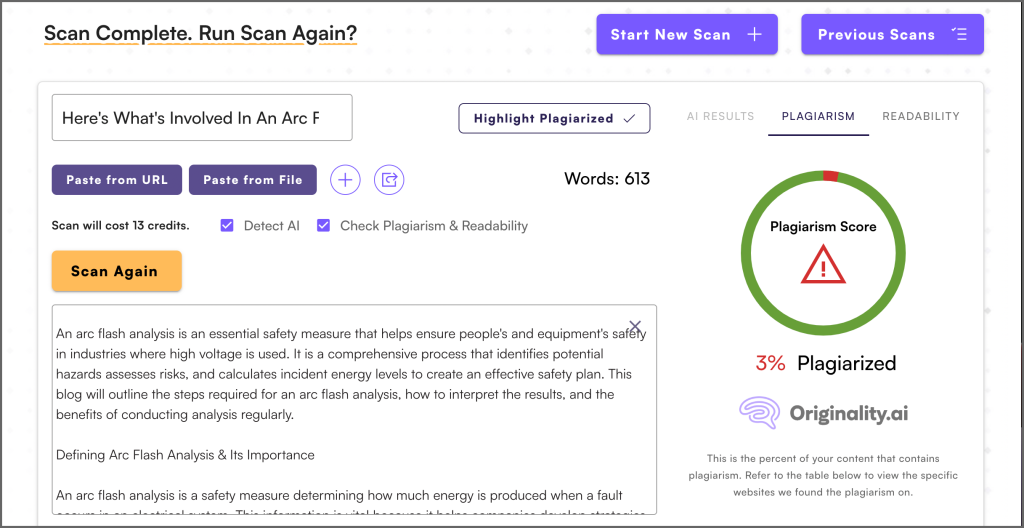
Originality.AI offers AI text generation and plagiarism detection, and is an excellent option for writers and educators. It detects text written by GPT-4, Claude, Gemini and other popular models. It’s fast and includes a percentage, so you can see exactly how much of your content was flagged. It’s paid, starting at about one cent per 100 words.
3. Copyleaks
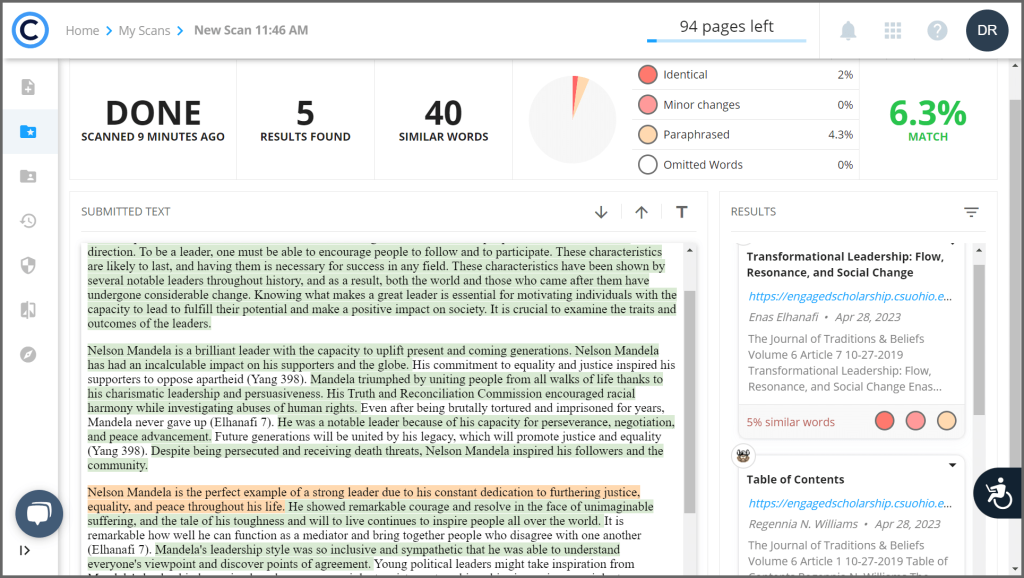
Copyleaks is an AI writing checker and plagiarism checker combined, and is used by both businesses and universities around the world. With support for more than 30 languages, it is one of the most internationally-focused AI writing detectors. It has a free plan that allows you to scan a certain number of pages each month, as well as plans for larger organisations, including API access.
4. Winston AI
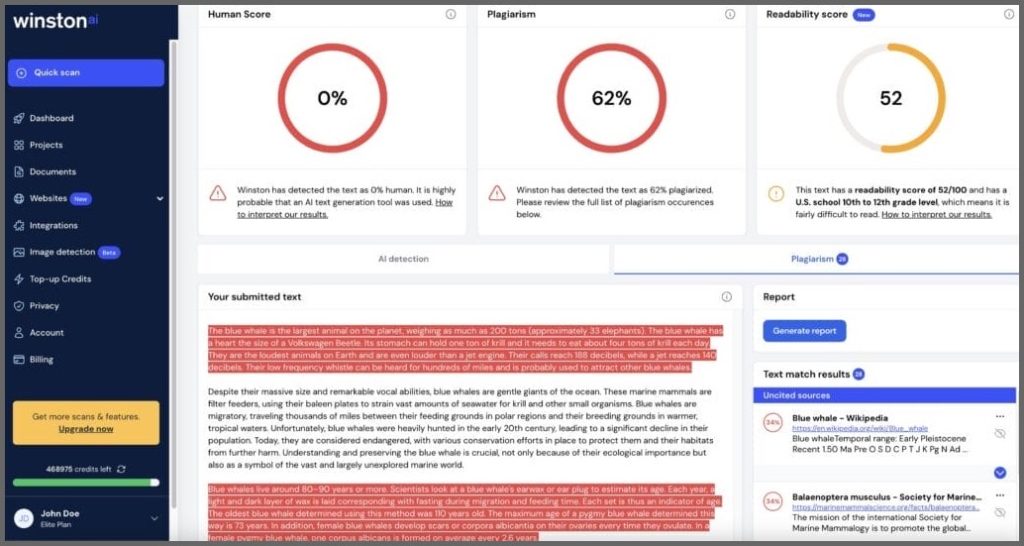
Winston AI is centred on accuracy, with detection rates of over 99% in their testing. It also offers a readability score, along with an AI detection score, if you’re looking to enhance both authenticity and readability. Users can try out the software with the free trial, which provides a number of scans.
5. Oreate AI General Humanizer
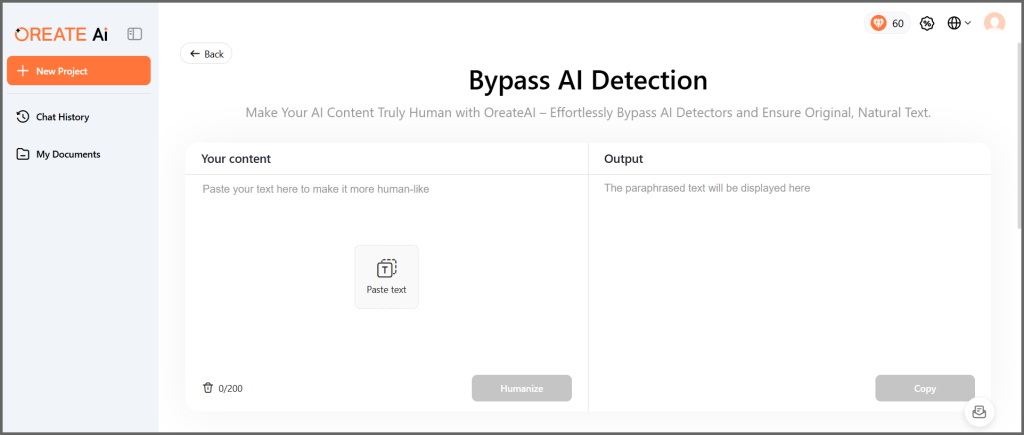
Oreate AI is a new 2025 AI workspace with a General Humanizer tool to help make AI content less detectable. What sets the Oreate AI General Humanizer apart from other AI detectors is that it automatically rewrites detected AI-written text to sound more human. It’s part of a comprehensive set of AI tools for writing, research, image and video creation, making it an appealing choice for students who need multiple types of content.
How to Make Your AI Essay Sound More Human
Using a free AI humanizer or revising your essay are both options. Here are some useful tips.
Add a Personal Angle
Replace abstract examples with specific ones tied to your experience or observation. Instead of “Many people find exercise beneficial,” write “I started running three times a week after noticing I was too tired to focus by afternoon.” Personal details are something AI cannot fake.
Vary Your Sentence Length Deliberately
Read your essay out loud. If all your sentences have the same cadence, try turning some into extremely short sentences. Then have others be longer in order to fully explain. Burstiness is a clear indicator of writing by humans and can avoid AI detection.
Cut Filler Phrases
Look for such filler phrases as “it is important to note” and “in conclusion” and “as mentioned above”, and “of course”. Delete them. Substitute each with the point you’re trying to make.
Use a Best Free AI Humanizer
Tools like the Oreate AI General Humanizer can automatically restructure the AI phrasing to be more human-like. Use the best free AI humanizer tool and then edit the results yourself to ensure you haven’t missed anything. Be sure to check it yourself; nothing is a substitute for your human instincts.
Introduce Controlled Imperfection
Humans use contractions, rhetorical questions and sometimes sentence fragments. AI doesn’t do any of this. Using them purposefully, sparingly, gives you a more human voice, without losing clarity. A rhetorical question or a mid-sentence in the middle of a paragraph is cheap, but adds humanity.
Swap Generic Vocabulary for Specific Words
AI prefers generic words. Instead of “significant,” use “striking,” instead of “utilize” use “use”, and instead of “facilitate” use “help.” Specific words and phrases make your essay sound human and also make it better, whether it was written by a person or by AI.
Reference Credible Sources
AI text doesn’t include specific references, names or dates. Use of an actual source, like a 2023 Stanford study about AI text detection or a reference to an expert in your field, instantly lends credibility. It also adds to your credibility. Readers will respect your work if you show you have done your homework, and AI detectors are more likely to rate referenced material as human.
Conclusion
Knowing what makes an AI-written essay detectable gives you an edge, whether you want to avoid accidentally triggering an AI checker as a student or get a more personal touch as a writer. AI writing checkers identify low perplexity, repetition, filler words and phrases, and a lack of personal voice. By using a trusted AI writing checker and following the editing advice in this article, you can bridge the gap between AI writing and human text.
The best way to do this is to use AI as a writing tool, not a writer. Allow it to do the grunt work on a draft, but then edit for your style, experience and expertise. Edit for tone. Add your examples. Cut the filler. This makes both the writing impossible to detect by AI and, more significantly, engaging to human audiences.
The problem with an essay written by AI writing is a lack of humanity. You just have to fill in the holes. And with the right tools and editing practices, you can do just that.
References
Stanford University. (2023). Detecting AI-Generated Text: Research and Methods. Retrieved from https://hai.stanford.edu
OpenAI. (2023). AI Text Classifiers and Detection Approaches. Retrieved from https://openai.com
Turnitin. (2023). AI Writing Detection Capabilities and Limitations. Retrieved from https://www.turnitin.com
GPTZero. (2024). How GPTZero Detects AI-Generated Text. Retrieved from https://gptzero.me
Originality.AI. (2024). AI Detection Technology Overview. Retrieved from https://originality.ai
Copyleaks. (2024). AI Content Detection and Plagiarism Checking. Retrieved from https://copyleaks.com
Winston AI. (2024). AI Detection Accuracy and Readability Metrics. Retrieved from https://gowinston.ai
Google DeepMind. (2023). Language Models and Text Generation Patterns. Retrieved from https://deepmind.google
MIT Technology Review. (2023). The Challenges of Detecting AI-Generated Text. Retrieved from https://www.technologyreview.com
Oreate AI. (2025). General Humanizer Tool Documentation. Retrieved from https://oreate.ai
Computational Linguistics literature on perplexity and burstiness in language modelling and AI detection systems.