Yes, AI can help you write a book, and it’s already helping thousands of writers finish manuscripts they’ve been sitting on for years. Still, can AI help me write a book from scratch with zero effort? Not quite.
The truth sits somewhere in the middle, and knowing where that line lands is the difference between a published draft and a wasted weekend.
Here’s what this guide covers:
● What AI can actually do for book writers (and what it can’t)
● A step-by-step tutorial for writing a book with AI
● Popular AI writing tools worth your time
● Answers to the biggest questions: copyright, publishing, editing
Ready to see what’s possible? Let’s break it down!
What Can AI Do for Book Writers?
AI supports book writing at almost every stage, from the first messy idea to the final polished draft. It won’t replace your creative voice, but it will remove friction from the grunt work that slows most writers down.
A May 2025 BookBub survey of 1,200+ authors found that 45% of authors now use AI in their workflow. The most common uses? Research (81%), marketing copy (73%), outlining (72%), and editing (70%).
Where AI Helps Authors
Here’s what AI writing tools realistically handle well:
● Brainstorming ideas, plot twists, and character backstories
● Outlining chapters and structuring arguments for nonfiction
● Drafting rough sections, you can later rewrite in your own voice
● Editing for grammar, flow, tone, and clarity
● Summarizing research from long articles or interviews
● Formatting citations and references (a huge time-saver for nonfiction)
● Writing book descriptions, marketing blurbs, and author bios
● Translating content into other languages
How to Write a Book with AI (Step by Step)
Can AI help me write a book from idea to final draft? Yes. The technique is treating AI as your co-pilot, not your autopilot. Here’s the exact workflow that works:
Scenario: Writing a Self-Help Book
Let’s say you want to write a self-help book titled “The 30-Minute Morning: A Productivity Playbook for Busy Professionals.” Target audience? People who want more structured mornings but have zero time for fluff.
Step 1: Define Your Book’s Foundation
Before touching any AI book generator, lock down these four things:
● Genre or category (self-help, nonfiction)
● Target reader (burned-out professionals, ages 28 to 45)
● Core promise (build a 30-minute routine that sticks)
● Tone (casual, no-nonsense, slightly funny)
Skip this step, and your AI output will feel generic.
Step 2: Generate a Detailed Outline
Open your AI tool. Conversational assistants like ChatGPT or Claude work especially well here because they let you guide the direction of your book in real time. Then prompt it to generate a chapter-by-chapter outline. Be specific. Something like:
“Create a 10-chapter outline for a self-help book titled ‘The 30-Minute Morning.’ Target audience: working professionals aged 28-45. Each chapter should include a title, a summary, and 3 key takeaways.”
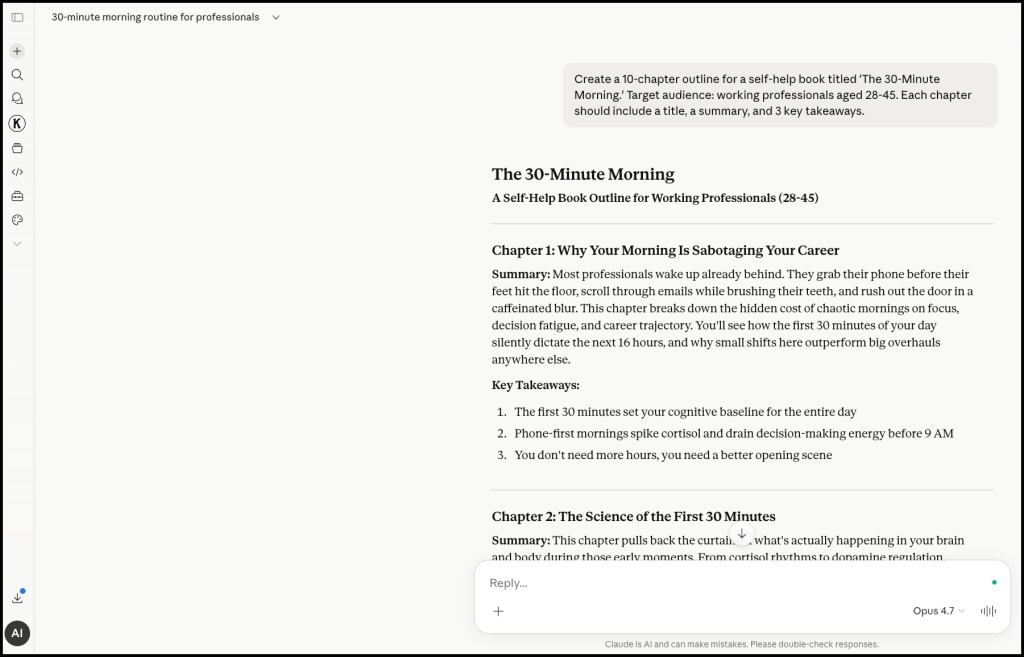
Review the outline. Cut what doesn’t fit. Add chapters where you have stronger personal stories to tell.
Step 3: Draft Chapters One at a Time
Feed the AI one chapter at a time. Why? Most AI tools lose context across long documents, so sequential drafting keeps continuity tight. A good prompt looks like this:
“Write Chapter 3: ‘The 30-Minute Morning Blueprint.’ Tone: casual and direct. Include one case study, two practical exercises, and a pro tip at the end. Target: 1,200 words.”
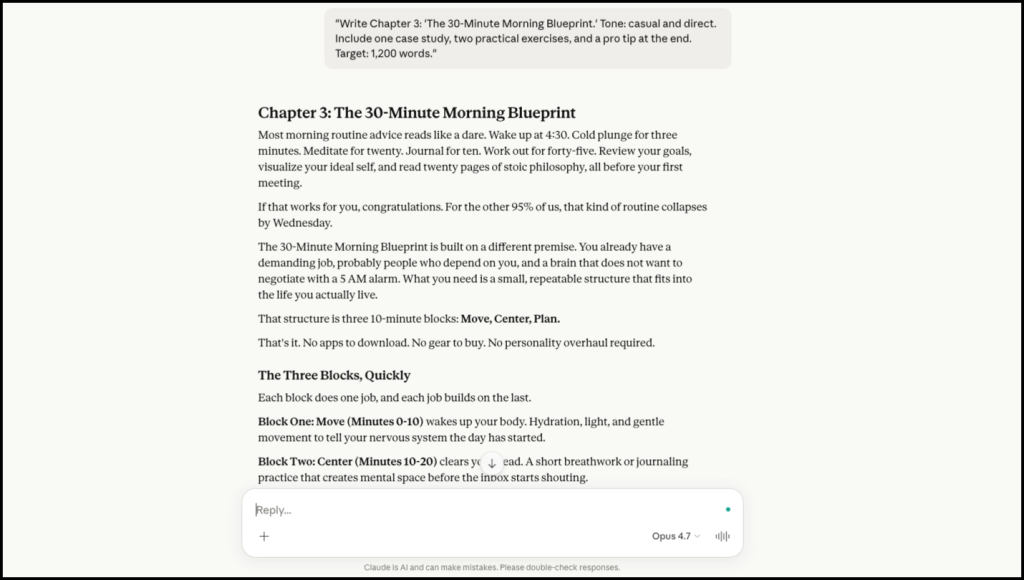
Step 4: Inject Your Voice
This is where most writers fail. AI drafts are starting points, not finished products. Rewrite each paragraph in your actual voice.
Add personal anecdotes, jokes, client stories, and industry-specific insights that only you can provide.
Step 5: Edit, Fact-Check, Polish
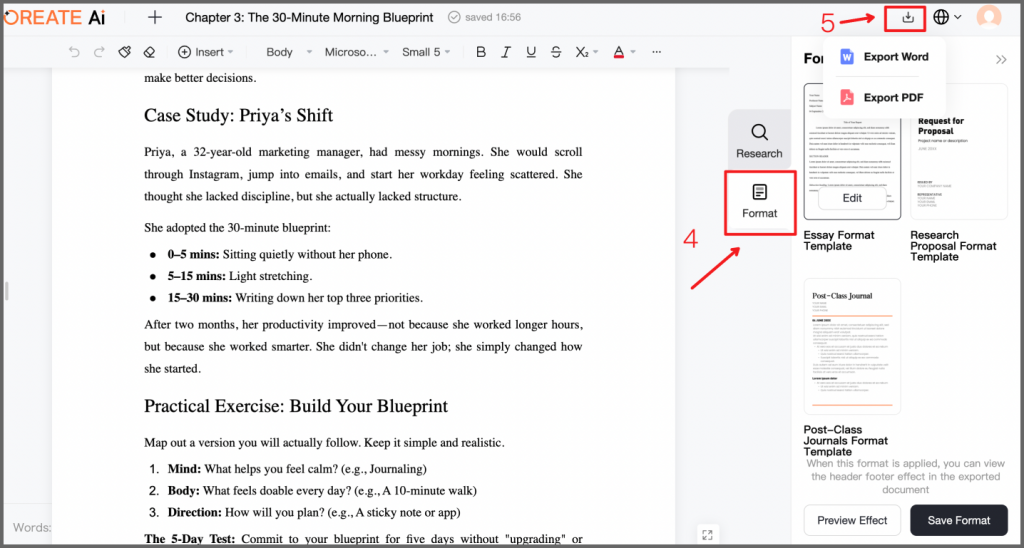
Run your draft through an AI content generator with built-in editing features to tighten grammar, pacing, and clarity. Tools like Oreate AI’s General Writer can help. It can refine your draft with basic editing, AI-powered improvements, and formatting adjustments, making the polishing stage faster and more consistent.
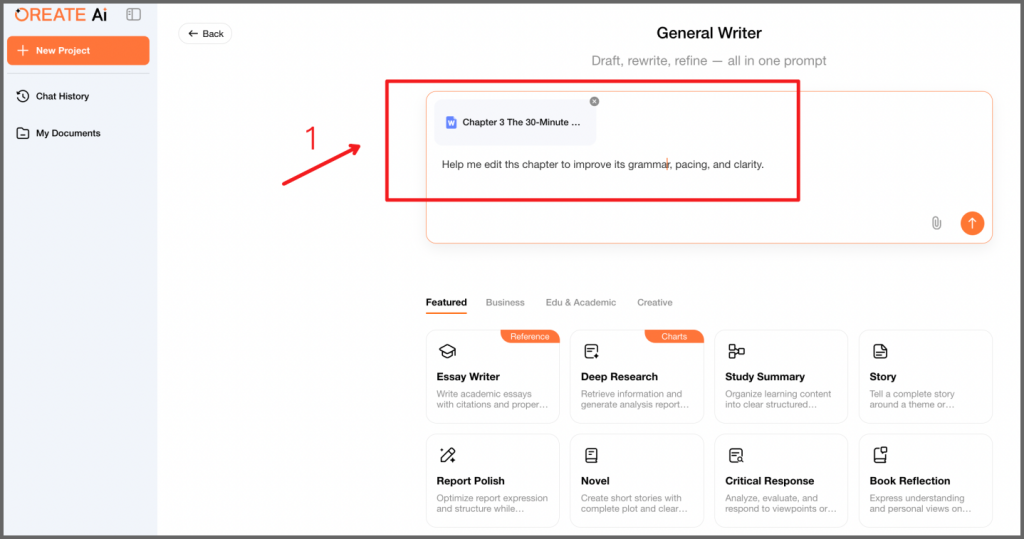
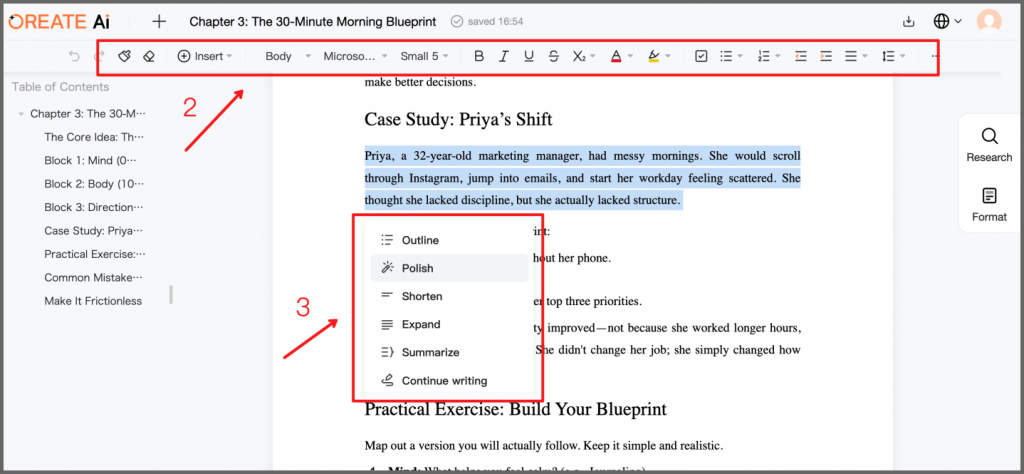
Then fact-check every stat, quote, and citation manually.
The U.S. Copyright Office confirms that AI hallucinations are still a real problem, so verify before you publish.
Step 6: Format and Export
Export your manuscript as a .docx or PDF format for your publishing platform (Amazon KDP, for example), and you’re ready to launch any edits here.
What AI Cannot Do for Book Writing
AI cannot replace your voice, your lived experience, or your creative judgment. No matter how advanced the AI writing tools get, there are hard limits that every author needs to understand before trusting AI with their manuscript.
It Can’t Think as You Do
AI doesn’t understand your content. It predicts what words statistically come next based on patterns from its training data.
That means it can fake polish, but it can’t replicate:
● Your lived experiences and personal stories
● Your emotional intuition about what readers need to hear
● Your unique worldview that shapes how you frame ideas
● Deep, original insight that only comes from years in your field
A book without those things reads like a Wikipedia article in a trench coat.
It Hallucinates Facts Confidently
AI makes things up. A lot. The Authors Guild explicitly warns that chatbots are text-completion tools, not information tools, and they regularly fabricate stats, quotes, studies, and citations.
Pro tip: Fact-check every single claim in your AI draft. Don’t trust it with names, numbers, or historical events without verification.
It Can’t Legally Own Your Book
The U.S. Copyright Office has ruled that AI-generated content cannot be copyrighted. Only human-authored work qualifies for full copyright protection.
In 2024, author Elisa Shupe received limited copyright for her AI-assisted novel, and that was only for her “selection, coordination, and arrangement” of the AI text. The prose itself? Not hers to own.
It Misses Emotional Nuance
AI writes technically correct sentences, but it often flatlines on emotion. Subtext, irony, tension, heartbreak, the slow reveal of a character’s inner conflict. These are still firmly in the human column.
Quick Reference: AI’s Hard Limits
|
Limitation |
What It Means for You |
|
No original insight |
Your expertise must fill the gap |
|
Hallucinates facts |
Fact-check every stat and quote |
|
No full copyright |
Your human input creates ownership |
|
No emotional depth |
You handle the moments that matter |
|
Can’t replace voice |
Rewrite drafts in your own style |
The takeaway? AI is a powerful assistant. It’s not a replacement for you.
Popular AI Tools That Help Write Books
Not every AI book generator offers the same value. Some excel at fiction, others at nonfiction, and a few specialize in academic or long-form writing.
Here are five popular tools worth knowing.
ChatGPT
ChatGPT is OpenAI’s flagship AI assistant and the most widely used writing tool on the planet. Powered by GPT-4o, it’s a go-to for brainstorming, outlining, and drafting flexible content across genres.
Key features:
● Strong at brainstorming plots, chapters, and character names
● Handles both fiction and nonfiction drafting well
● Free tier available with GPT-4o
● Pro plan at $20/month unlocks longer sessions and priority access
● No native book formatting or export features
Sudowrite
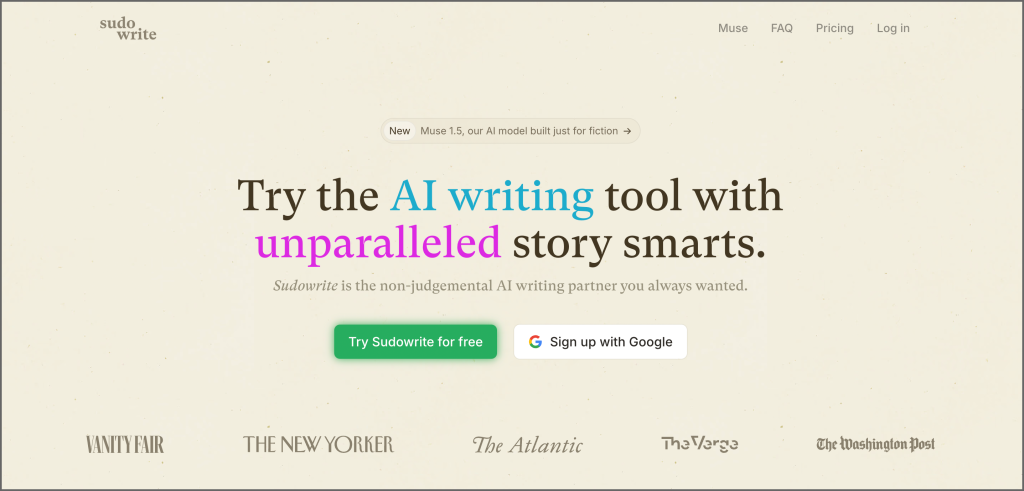
Sudowrite is the fiction specialist. Built by novelists for novelists, it focuses on story consistency, sensory detail, and long-form manuscript management.
Key features:
● Proprietary “Muse” model trained specifically on fiction
● Story Bible tracks characters, plot threads, and world-building
● Best for genre fiction (romance, thriller, fantasy, sci-fi)
● Pricing starts at $19/month (Hobby plan)
● Not suited for nonfiction
Oreate AI General Writer
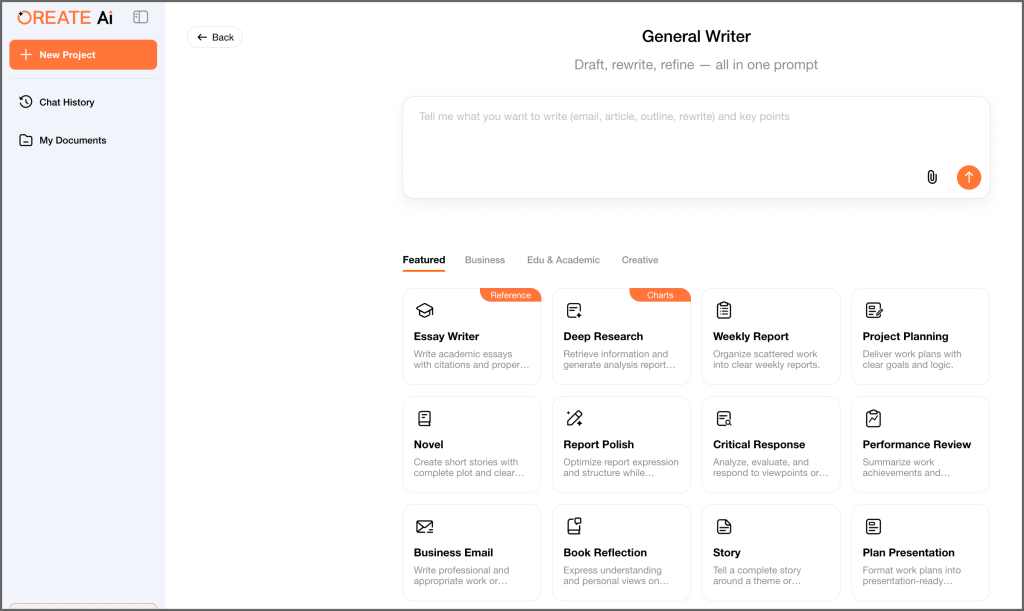
Oreate AI General Writer is an all-in-one writing workspace that leans academic and long-form. It generates structured essays up to 20,000 words, formats real citations, and includes built-in plagiarism detection. For authors writing nonfiction, research-heavy guides, or academic books, Oreate AI handles the grunt work that usually eats up weeks.
Key features:
● Essay and long-form generation up to 20,000 words
● Auto-formatted citations in APA.
● Built-in plagiarism checker for originality verification
● AI humanizer to smooth out robotic-sounding drafts
● Paraphrasing, summarizing, and smart editing tools
● Free plan available, Pro starts at $7.9/month
Claude
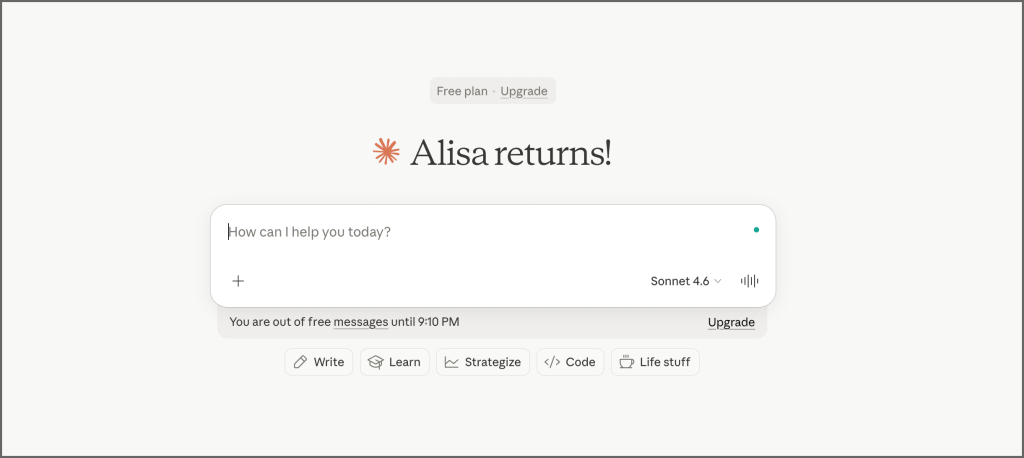
Claude by Anthropic is known for nuanced reasoning and a large context window (up to 200K tokens), which means it can hold an entire manuscript in memory. Writers love it for complex subjects and high-quality prose.
Key features:
● Excellent for academic and research-heavy books
● Produces some of the most polished prose of any LLM
● Free tier available, Pro at $19/month
● No native book formatting or export
Jasper
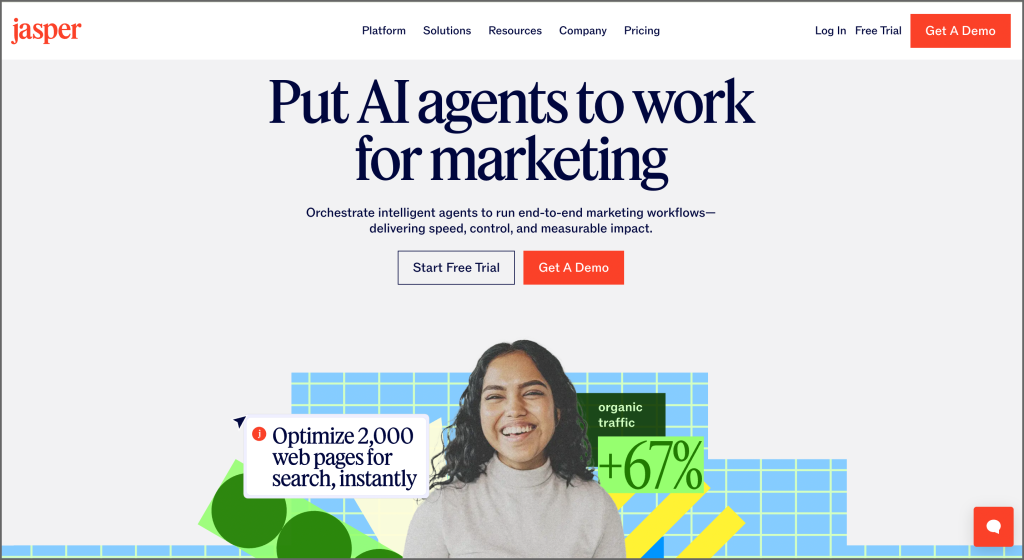
Jasper started as a marketing copy tool and expanded into long-form. It’s particularly useful for authors balancing manuscript writing with promotional content like blurbs, ads, and email marketing.
Key features:
● Strong for marketing-focused nonfiction and lead magnets
● Brand Voice feature keeps the tone consistent across platforms
● Templates for book descriptions, author bios, and ads
● Pricing starts at $69/month (Creator plan)
Quick Comparison Table
|
Tool |
Best For |
Starting Price |
|
ChatGPT |
General brainstorming and drafting |
Free / $20/mo |
|
Sudowrite |
Fiction and novels |
$19/mo |
|
Oreate AI |
Academic and long-form nonfiction |
Free / $7.9/mo |
|
Claude |
Complex, research-heavy books |
Free / $19/mo |
|
Jasper |
Book marketing and copy |
$69/mo |
Pick the one that matches your genre and workflow. Most working authors use two or three together.
FAQs
Can I publish a book written with AI?
Yes, you can publish AI-assisted books on most platforms, including Amazon KDP. However, Amazon requires disclosure of AI-generated content when you publish or update a book. Traditional publishers often have stricter rules, so check contract terms before signing.
Does AI-written content have copyright protection?
Only partially. The U.S. Copyright Office has ruled that purely AI-generated text cannot be copyrighted. You can only claim copyright over the human-authored parts, which means your edits, additions, and creative arrangement of the content.
How much editing does AI-written content need?
A lot. Plan for 2 to 5 hours of editing per chapter to add your voice, fact-check claims, smooth awkward phrasing, and inject personal stories. AI gives you a rough first draft, not a finished manuscript.
Will readers know I used AI?
They often can. AI-generated prose tends to sound generic, repetitive, or overly polished. The fix? Rewrite in your voice, add specific examples, and break predictable patterns. Tools with built-in humanizers (like Oreate AI) can also help smooth AI-heavy drafts.
Can AI plagiarize other authors?
Unintentionally, yes. AI trains on massive datasets that include copyrighted books, so overlap is possible. Always run your draft through a plagiarism checker before publishing.
Is it ethical to use AI for book writing?
The Authors Guild says AI is fine as a tool for brainstorming, editing, and research. It becomes ethically murky when AI writes substantial portions, and you claim full authorship. Be transparent, stay in control, and disclose where required.
Conclusion
So, can AI help me write a book? Absolutely, as long as you treat it like a partner instead of a ghostwriter. AI speeds up outlining, drafting, editing, and research. It clears the blank-page paralysis that stalls most writers. It handles the grunt work so you can focus on the ideas, stories, and insights only you can bring.
What AI won’t do is replace your voice, your expertise, or your creative judgment. Those are still yours to own.
Ready to turn your idea into a finished book? Pick one of the AI writing tools covered above, start with a clear outline, and let AI help you draft faster than you thought possible. Can AI help me write a book? Only if you show up with the ideas. Let the AI handle the heavy lifting.